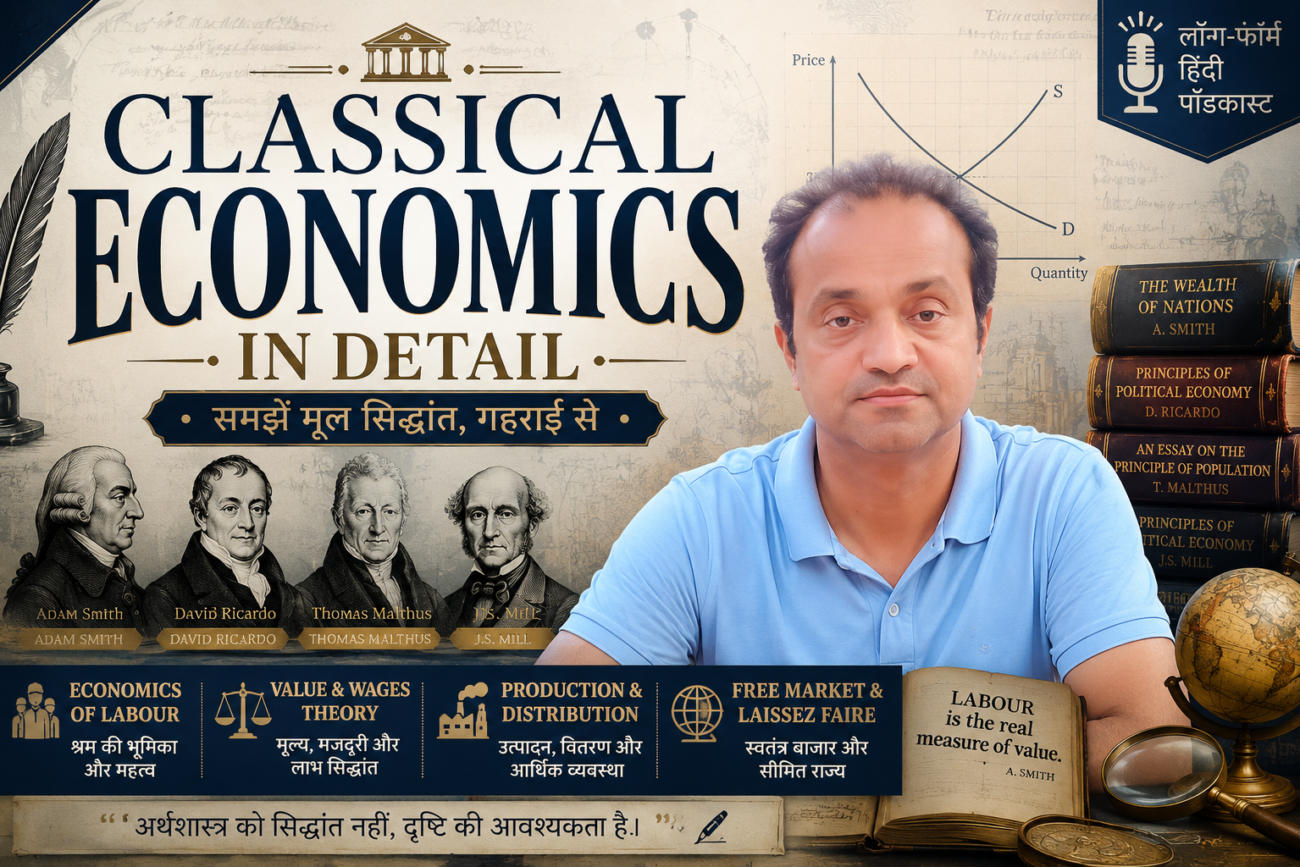
Understanding Classical Economics and Its Historical Emergence
Classical Economics occupies a prominent place in the history of economic thought and is widely regarded as the foundation upon which modern economics was built. The emergence of Classical Economics during the late eighteenth century marked a turning point in humanity’s understanding of wealth, production, trade, and economic development. Prior to the rise of the Classical School, economic policies were largely influenced by Mercantilism, which emphasized government control, trade restrictions, and the accumulation of gold and silver as indicators of national wealth. However, as industrialization began transforming European societies, economists started searching for new explanations of economic prosperity.
The publication of The Wealth of Nations in 1776 by Adam Smith initiated a revolutionary shift in economic thinking. Smith challenged traditional beliefs and argued that the true wealth of a nation lies not in its stockpile of precious metals but in its ability to produce goods and services efficiently. This idea became the cornerstone of Classical Economic Theory and paved the way for the development of free-market economics.
Classical Economics emerged during the Industrial Revolution, a period characterized by rapid technological advancements, factory-based production, urbanization, and expanding international trade. These transformations created new economic realities that required fresh analytical frameworks. Classical economists sought to understand how markets function, how prices are determined, how resources are allocated, and what factors contribute to long-term economic growth.
The significance of Classical Economics extends beyond its historical origins. Many of the concepts introduced by Classical economists continue to influence contemporary economic policies, business strategies, and academic research. Ideas such as free markets, competition, specialization, productivity, and economic freedom remain central to modern economic discussions. Consequently, understanding Classical Economics is essential for anyone seeking to explore the evolution of economic thought and the foundations of today’s global economy.
Adam Smith and the Birth of Classical Economic Theory
No discussion of Classical Economics can begin without recognizing the immense contribution of Adam Smith, often referred to as the Father of Economics. His groundbreaking work, The Wealth of Nations, transformed economics from a collection of philosophical observations into a systematic and scientific discipline. Smith’s ideas laid the intellectual foundation for the Classical School of Economics and continue to shape economic thinking more than two centuries later.
One of Smith’s most influential concepts was the idea of the “Invisible Hand.” According to this theory, individuals pursuing their own self-interest inadvertently contribute to the welfare of society. When producers seek profits and consumers seek value, market forces coordinate their actions in ways that promote efficiency and economic growth. This process occurs without the need for extensive government intervention.
Smith also emphasized the importance of the division of labor. He observed that productivity increases significantly when workers specialize in specific tasks rather than attempting to perform multiple activities simultaneously. His famous example of a pin factory demonstrated how specialization could dramatically increase output and efficiency. The principle of division of labor remains one of the most important concepts in economic theory and business management today.
Another major contribution of Adam Smith was his advocacy of free markets and economic freedom. He argued that competitive markets encourage innovation, lower prices, improve product quality, and allocate resources more efficiently than centralized planning. According to Smith, governments should primarily focus on maintaining law and order, protecting property rights, and providing essential public goods while allowing markets to operate freely.
The ideas presented by Adam Smith fundamentally changed perceptions of wealth creation and economic development. By emphasizing productivity, specialization, and market competition, he established principles that became central to Classical Economics and continue to influence economic policy worldwide.
Major Principles and Assumptions of Classical Economics
Classical Economics is built upon a set of fundamental principles and assumptions that define its approach to understanding economic activity. These principles provide a framework for analyzing how individuals, businesses, and markets interact within an economy.
One of the most important assumptions of Classical Economics is that individuals are rational decision-makers. Consumers seek to maximize satisfaction, while producers aim to maximize profits. These rational choices drive economic activity and help allocate resources efficiently. Classical economists believed that when individuals are free to pursue their interests, the overall economy benefits through increased productivity and innovation.
Another core principle is the belief in free markets. Classical economists argued that market prices should be determined by the forces of demand and supply rather than government regulation. Prices serve as signals that guide producers and consumers, helping to allocate scarce resources where they are most needed. Through the price mechanism, markets naturally move toward equilibrium.
Competition is another essential feature of Classical Economic Theory. Competitive markets encourage businesses to improve efficiency, reduce costs, and develop better products. In the absence of competition, monopolies may emerge, reducing consumer welfare and economic efficiency. Therefore, Classical economists viewed competition as a critical driver of economic progress.
Classical Economics also assumes that wages and prices are flexible. If unemployment occurs, wages will adjust downward, encouraging businesses to hire more workers and restoring full employment. Similarly, changes in supply and demand will cause prices to adjust until markets reach equilibrium. This belief led Classical economists to conclude that economies are generally self-correcting and capable of achieving long-term stability.
The assumption of limited government intervention further distinguishes Classical Economics. While governments have important roles in maintaining security and enforcing contracts, excessive regulation is believed to hinder economic efficiency and growth. These assumptions collectively form the theoretical foundation of the Classical School and continue to influence free-market economic policies around the world.
Contributions of David Ricardo, Malthus, Say, and Mill
While Adam Smith established the foundations of Classical Economics, several other economists expanded and refined the theory, making significant contributions to the development of economic thought. Among these scholars, David Ricardo, Thomas Robert Malthus, Jean-Baptiste Say, and John Stuart Mill played particularly important roles.
David Ricardo is best known for developing the Theory of Comparative Advantage, one of the most influential concepts in international economics. Ricardo demonstrated that countries can benefit from trade even when one nation is more efficient at producing all goods. By specializing in products where they possess a comparative advantage and trading with other nations, countries can increase overall production and improve living standards. This theory remains a cornerstone of modern international trade policy.
Thomas Robert Malthus contributed to Classical Economics through his analysis of population growth and resource availability. Malthus argued that population tends to grow faster than food production, potentially leading to poverty and resource scarcity. Although technological advancements later challenged many of his predictions, his work sparked important debates about sustainability, economic growth, and population dynamics.
Jean-Baptiste Say introduced Say’s Law, which states that supply creates its own demand. According to this principle, the act of producing goods generates income that can be used to purchase other goods and services. Classical economists used this theory to argue that economies naturally move toward full employment and that widespread overproduction is unlikely.
John Stuart Mill further refined Classical Economic Theory by integrating social and ethical considerations into economic analysis. While supporting free markets and economic liberty, Mill recognized the importance of addressing issues such as poverty, education, and social welfare. His work helped bridge the gap between traditional Classical Economics and later economic schools.
Together, these economists enriched Classical Economic Theory and expanded its application to areas such as international trade, population studies, employment, and social policy. Their contributions continue to influence economic research and policymaking in the modern world.
Classical Economics, Economic Growth, and Market Efficiency
One of the greatest strengths of Classical Economics lies in its explanation of economic growth and market efficiency. Classical economists sought to understand why some nations prosper while others remain economically stagnant. Their analysis focused on productivity, capital accumulation, specialization, and market competition as the primary drivers of long-term economic development.
According to Classical Economic Theory, economic growth occurs when societies increase their productive capacity. Investments in machinery, infrastructure, technology, and human capital enable businesses to produce more goods and services with the same amount of resources. This increase in productivity raises incomes, improves living standards, and contributes to national prosperity.
The division of labor plays a crucial role in promoting economic growth. By specializing in specific tasks, workers become more skilled and efficient, leading to higher output. Businesses can reduce production costs, increase profitability, and expand operations. This process generates employment opportunities and stimulates further economic activity.
Classical economists also emphasized the importance of capital accumulation. Savings and investments provide the resources needed to finance new factories, equipment, and technological innovations. As capital stock increases, economies become more productive and capable of supporting larger populations and higher standards of living.
Market efficiency is another central theme of Classical Economics. Competitive markets encourage producers to allocate resources effectively and respond to consumer preferences. The price system serves as a communication mechanism, signaling where resources should be directed. As a result, markets tend to achieve efficient outcomes without extensive government intervention.
Although modern economists recognize certain limitations of market systems, the Classical emphasis on productivity, specialization, competition, and investment remains highly relevant. Many successful economies continue to rely on these principles to promote sustainable economic growth and development.
Criticisms, Legacy, and Modern Relevance of Classical Economics
Despite its enormous contributions, Classical Economics has faced criticism from later schools of economic thought. Critics argue that some of its assumptions are overly simplistic and do not accurately reflect real-world economic conditions. Nevertheless, the legacy of Classical Economics remains remarkably strong and continues to shape economic discourse today.
One major criticism concerns the assumption of full employment. Classical economists believed that flexible wages and prices would automatically restore equilibrium in labor markets. However, economic crises such as the Great Depression demonstrated that unemployment can persist for extended periods despite wage adjustments. This observation led economists like John Maynard Keynes to advocate greater government intervention during economic downturns.
Another criticism involves the assumption of perfect competition. In reality, many industries are dominated by large corporations with significant market power. Monopolies and oligopolies can distort prices, reduce competition, and limit consumer choice. Modern economists therefore recognize the need for regulatory frameworks to address market failures.
Classical Economics has also been criticized for paying insufficient attention to income inequality and social welfare. While free markets can generate wealth, they may not distribute that wealth evenly across society. Contemporary economic policies often seek to balance market efficiency with concerns about equity and social justice.
Despite these criticisms, the influence of Classical Economics remains profound. Concepts such as free trade, comparative advantage, market competition, entrepreneurship, and economic incentives continue to guide economic policy and business decision-making. Many governments promote economic liberalization, private enterprise, and international trade based on principles originally developed by Classical economists.
The enduring relevance of Classical Economics demonstrates its importance in understanding how economies function and evolve. From Adam Smith’s Invisible Hand to Ricardo’s Comparative Advantage, the ideas of the Classical School continue to shape discussions about economic growth, globalization, public policy, and prosperity. As a result, Classical Economics remains an essential chapter in the history of economic thought and a vital foundation for the study of modern economics.