
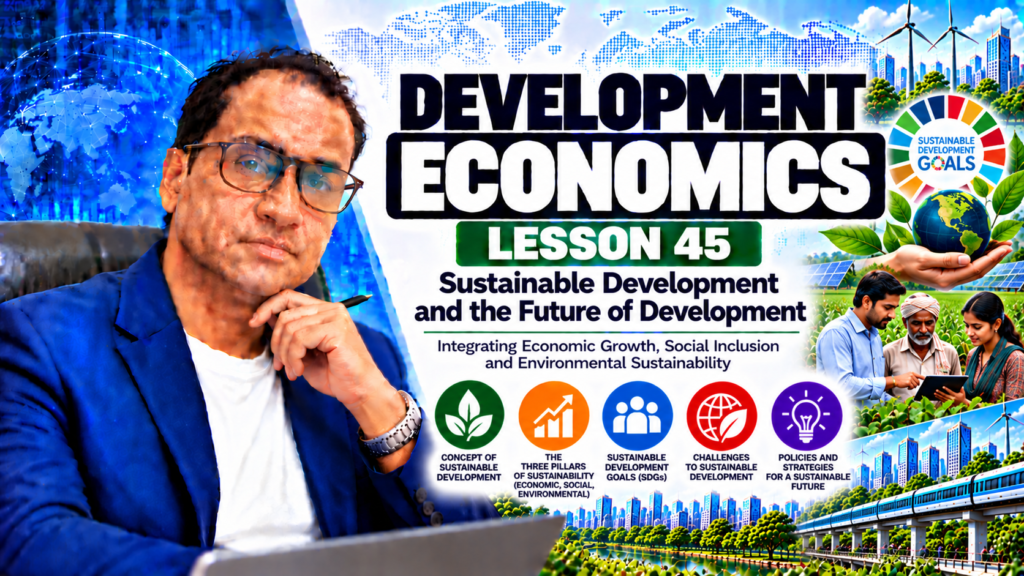
Lesson 45: Small and Medium Enterprises (SMEs) and Economic Development
Lesson Overview
Small and Medium Enterprises, commonly known as SMEs, occupy an important position in the development process of both developing and developed economies. They include a wide range of businesses, from small manufacturing units, retail shops, restaurants, repair services and agricultural-processing enterprises to technology firms, professional services and growing export-oriented companies. Although individual SMEs may be small in terms of capital, employment or output, their collective contribution to an economy can be substantial.
In developing economies, SMEs are particularly important because they can create employment, encourage entrepreneurship, support household incomes, develop local supply chains and provide goods and services to markets that may not be served adequately by large corporations.
At the same time, SMEs often face serious constraints, including limited access to finance, inadequate infrastructure, technological weaknesses, shortage of skilled workers, complicated regulations and difficulties in reaching larger domestic and international markets.
This lesson examines the economic role of SMEs, their contribution to development, the constraints they face, and the policies that can help them become more productive and competitive. The discussion also connects SMEs with industrialization, structural transformation, innovation, employment and inclusive economic development.
1. Meaning and Nature of Small and Medium Enterprises
Small and Medium Enterprises are businesses that operate on a relatively smaller scale than large corporations. The exact definition of an SME differs across countries because governments may use different criteria such as the number of employees, annual turnover, value of assets or amount of investment. Therefore, there is no single worldwide definition that applies equally to every economy. The important feature is that SMEs generally operate with more limited resources and organizational scale than large enterprises.
SMEs can be found in almost every sector of an economy. They may operate in manufacturing, agriculture, food processing, construction, transportation, retail trade, tourism, information technology, professional services and many other activities. A small furniture workshop, a local garment producer, a family-owned food-processing unit and a technology start-up may all fall within the broad category of SMEs even though their business models are very different.
One of the most important characteristics of SMEs is their relatively close relationship with local markets. Small enterprises often understand local consumer preferences and can respond quickly to changes in demand. Their smaller organizational structure can allow owners and managers to make decisions more rapidly than large organizations with complex administrative systems.
However, small scale also creates disadvantages. SMEs may have fewer financial resources, limited bargaining power with suppliers and customers, weaker access to advanced technology and fewer opportunities to spread fixed costs across a large volume of production. Consequently, an important development challenge is not simply increasing the number of SMEs but improving their productivity, survival, competitiveness and capacity to grow.
2. SMEs and Employment Creation
Employment generation is one of the most important contributions of SMEs to economic development. In many developing economies, a large share of workers obtain employment through small businesses, family enterprises and other relatively small productive activities. SMEs can therefore serve as an important bridge between households seeking income and markets demanding goods and services.
Small enterprises can be particularly important for young workers entering the labour market. A newly established business may begin with only a few employees but can create additional employment as demand increases. Entrepreneurship therefore provides an alternative to dependence on a limited number of large employers.
SMEs can also absorb workers released from traditional sectors during structural transformation. When workers move from low-productivity agricultural activities toward manufacturing and services, small firms can provide opportunities for employment close to their communities. This can contribute to a gradual movement of labour toward more productive activities.
Nevertheless, the quantity of employment should not be confused with the quality of employment. Some small enterprises provide stable jobs, training and opportunities for advancement, while others may operate with low wages, limited social protection and uncertain working conditions. Development policy therefore needs to focus not only on creating employment but also on improving productivity, earnings, skills and working conditions.
3. SMEs, Entrepreneurship and Economic Development
Entrepreneurship is closely connected with SME development. Entrepreneurs identify market opportunities, organize resources, accept business risks and introduce new products or methods of production. Successful entrepreneurship can transform an economic opportunity into productive activity.
In developing economies, entrepreneurship can contribute to economic development by creating new businesses and encouraging competition. When entrepreneurs enter markets, established businesses may face pressure to improve quality, reduce costs and introduce new products. This competitive process can improve the efficiency of the wider economy.
Entrepreneurship can also encourage innovation. Innovation does not necessarily mean inventing completely new technologies. It may involve introducing a new product, improving production methods, using digital marketing, developing a more efficient distribution system or finding a new way of serving customers.
However, entrepreneurship does not automatically produce development. Entrepreneurs require an environment in which property rights are reasonably secure, contracts can be enforced, infrastructure is available, finance can be accessed and regulations are sufficiently predictable. When these conditions are weak, potentially productive entrepreneurs may remain in very small-scale activities or avoid formal business expansion.
The distinction between opportunity-driven entrepreneurship and necessity-driven entrepreneurship is also useful. Some individuals establish businesses because they identify profitable opportunities, while others enter self-employment because they cannot find satisfactory wage employment. These forms of entrepreneurship can have different implications for productivity and long-term business growth.
4. Access to Finance and SME Development
Access to finance is one of the major challenges facing many SMEs. A business may have a profitable idea but still be unable to expand because it cannot obtain sufficient working capital or investment finance.
Financial institutions often perceive small businesses as riskier borrowers because they may have limited collateral, short operating histories, incomplete financial records or uncertain cash flows. Banks may therefore demand collateral or charge higher interest rates. This can make formal credit difficult for small entrepreneurs to obtain.
Finance is needed for many purposes. A business may require working capital to purchase raw materials, investment capital to buy machinery, funds to hire workers, or financing to expand into new markets. Without adequate finance, an enterprise may remain trapped at a very small scale even when demand exists for its products.
Microfinance, commercial bank lending, credit guarantees, development-finance institutions, venture capital and digital financial services can provide different forms of financial support. However, finance alone cannot guarantee SME success. If enterprises lack managerial skills, market access or appropriate technology, additional borrowing may increase financial risk rather than productivity.
A sound SME-finance system therefore needs to combine access to capital with financial literacy, transparent lending practices, appropriate risk assessment and business-development support.
5. SMEs, Productivity, Technology and Innovation
Productivity is central to the long-term contribution of SMEs to development. An enterprise may employ many workers but still contribute relatively little to economic growth if each worker produces very little output. Increasing productivity allows firms to produce more efficiently, improve wages and become more competitive.
Technology can play a major role in this process. Modern machinery, digital accounting systems, online marketing, electronic payments, cloud-based services and improved production techniques can help small firms reduce costs and reach customers more efficiently.
However, technology adoption among SMEs may be constrained by high initial costs, lack of technical knowledge, unreliable infrastructure and shortage of skilled workers. A small business owner may recognize the potential benefits of new technology but lack the resources necessary to implement it successfully.
Business networks, industrial associations, technology centres, vocational training institutions and universities can help overcome these barriers. Knowledge-sharing networks are particularly valuable because small firms can learn from one another and reduce the cost of experimenting with new technologies.
Productivity growth is especially important when SMEs seek to move from informal and low-value activities toward formal, higher-value production. The objective of development policy should therefore be to create conditions under which productive firms can survive, expand and integrate into larger value chains.
6. SMEs, Industrial Clusters and Value Chains
SMEs do not always operate independently. Many become part of industrial clusters and supply chains in which different firms specialize in different stages of production. This specialization can create efficiency gains.
For example, a manufacturing cluster may contain firms producing components, packaging materials, machinery parts and finished products. Supporting firms may provide transportation, accounting, maintenance, marketing and financial services. The concentration of businesses can create a network of specialized capabilities.
Clusters can generate what economists describe as external economies. Firms may benefit from a common pool of skilled labour, specialized suppliers, shared knowledge and improved access to markets. Workers can also move between firms, carrying knowledge and experience with them.
SMEs can also participate in domestic and international value chains. A small enterprise may supply components to a larger manufacturer or provide services to an exporting company. Participation in such networks can expose SMEs to higher standards of quality, technology and management.
However, entering value chains can be difficult. Large buyers may require reliable delivery, standardized quality, certification and sophisticated financial or digital systems. Governments and business-support institutions can help SMEs meet these requirements through training, certification assistance, infrastructure and market information.
7. SMEs, Formalization and Inclusive Development
A significant number of small enterprises in developing economies operate informally. Informal enterprises may not be fully registered with government authorities, may operate outside formal taxation systems or may lack access to formal financial and legal institutions. Informality is not necessarily a sign that an enterprise is unproductive, but persistent informality can create important constraints.
Formalization can provide benefits such as access to formal credit, legal protection, government support programmes, larger markets and business contracts. Formal businesses may also find it easier to participate in supply chains and export markets.
At the same time, formalization can impose costs. Registration fees, taxation, licensing requirements, paperwork and regulatory compliance can be difficult for very small enterprises. If formalization is expensive or complicated, entrepreneurs may have incentives to remain informal.
A development-oriented approach therefore seeks to reduce unnecessary barriers while maintaining reasonable standards for taxation, labour protection, consumer safety and environmental regulation. Simplifying registration, improving digital government services and providing information can make formalization easier.
SMEs can contribute to inclusive development when opportunities for entrepreneurship and business growth are accessible to people across different regions and income groups. Women, young entrepreneurs and people in rural areas may benefit from targeted access to finance, training, technology and markets when such programmes are appropriately designed.
8. SMEs, Industrialization and Long-Term Economic Transformation
SMEs are closely connected with industrialization and structural transformation. As economies develop, labour and resources generally move from lower-productivity activities toward higher-productivity manufacturing and services. SMEs can participate in this process by creating new productive enterprises and supporting larger industries.
In the early stages of development, many small firms may operate at low productivity. Over time, some enterprises can adopt better technology, improve management, gain access to finance and expand their markets. A successful SME can gradually become a medium-sized or even large enterprise.
This process is important because economic development is not simply about increasing the number of businesses. It involves creating an environment in which productive enterprises can grow while inefficient activities gradually lose resources. Competition, innovation and investment are therefore important components of SME development.
Governments can support this process through reliable infrastructure, education and skills development, financial-sector development, fair competition, technology policies, efficient taxation and predictable regulations. Policies should avoid protecting inefficient firms indefinitely because permanent protection can reduce competition and discourage productivity improvements.
The environmental dimension is also increasingly important. SMEs involved in manufacturing, transport, construction, agriculture and other activities may generate pollution or use significant quantities of energy and natural resources. Supporting cleaner technologies, energy efficiency and environmentally responsible production can allow SME development to occur alongside sustainable development.
The long-term objective is therefore to create a dynamic enterprise sector in which productive SMEs can innovate, create employment, participate in value chains and contribute to rising living standards. When supported by appropriate institutions and markets, SMEs can become an important part of the broader transformation from a low-productivity economy toward a diversified and productive economy.
Key Concepts
- Small and Medium Enterprises (SMEs): Businesses operating on a relatively smaller scale than large enterprises, defined according to criteria that vary across countries.
- Entrepreneurship: The process of identifying opportunities, organizing resources, taking business risks and creating economic activity.
- Productivity: The amount of output produced from a given quantity of inputs.
- Access to Finance: The ability of businesses to obtain appropriate financial resources for investment and working capital.
- Formalization: The process through which an informal enterprise becomes legally recognized and integrated into the formal economy.
- Industrial Cluster: A geographical concentration of interconnected firms, suppliers, workers and supporting institutions.
- Value Chain: The sequence of activities through which inputs are transformed into goods or services and delivered to consumers.
- Structural Transformation: The movement of labour and resources from lower-productivity activities toward higher-productivity sectors.
- Innovation: The introduction or adoption of new products, processes, technologies or organizational methods.
- Inclusive Development: Economic development in which opportunities and benefits are accessible across different groups of society.
Review Questions
A. Multiple-Choice Questions
1. What does SME generally refer to?
A. Only agricultural enterprises
B. Small and medium-sized businesses
C. Government-owned corporations
D. International financial institutions
Answer: B. Small and medium-sized businesses
2. Which is an important contribution of SMEs to economic development?
A. Employment creation
B. Elimination of all competition
C. Reduction of entrepreneurship
D. Elimination of markets
Answer: A. Employment creation
3. Why may SMEs experience difficulty obtaining bank loans?
A. They always have excessive collateral
B. They may have limited collateral and financial records
C. They never require finance
D. Banks cannot lend to any business
Answer: B. They may have limited collateral and financial records
4. Productivity refers primarily to:
A. The number of business owners
B. Output produced relative to inputs
C. The size of a country’s population
D. The number of banks in an economy
Answer: B. Output produced relative to inputs
5. What is entrepreneurship primarily associated with?
A. Identifying opportunities and organizing resources
B. Eliminating investment
C. Preventing innovation
D. Reducing market activity
Answer: A. Identifying opportunities and organizing resources
6. An industrial cluster is:
A. A group of unrelated governments
B. A geographical concentration of interconnected economic activities
C. A national taxation system
D. A monetary policy institution
Answer: B. A geographical concentration of interconnected economic activities
7. What can technology adoption help SMEs achieve?
A. Lower productivity
B. Higher production costs in every situation
C. Greater efficiency and market access
D. Elimination of entrepreneurship
Answer: C. Greater efficiency and market access
8. Formalization may provide SMEs with better access to:
A. Formal finance and legal protection
B. Informal markets only
C. Unregulated activities
D. Fewer customers
Answer: A. Formal finance and legal protection
9. Structural transformation involves:
A. Moving resources toward higher-productivity activities
B. Eliminating manufacturing
C. Preventing labour mobility
D. Reducing economic diversification
Answer: A. Moving resources toward higher-productivity activities
10. Which factor can restrict SME growth?
A. Improved infrastructure
B. Access to skilled workers
C. Limited access to finance
D. Better technology
Answer: C. Limited access to finance
B. True or False
- SMEs can contribute significantly to employment creation.
Answer: True - All countries use exactly the same definition of an SME.
Answer: False - SMEs can operate in manufacturing and services.
Answer: True - Access to finance has no relationship with SME growth.
Answer: False - Productivity is important for long-term SME competitiveness.
Answer: True - Industrial clusters can generate benefits through specialization and knowledge sharing.
Answer: True - All informal businesses are necessarily completely unproductive.
Answer: False - Technology can improve SME productivity when appropriate conditions exist.
Answer: True - Entrepreneurship can contribute to innovation and competition.
Answer: True - Permanent protection of inefficient enterprises always increases economic efficiency.
Answer: False
C. Fill in the Blanks
- SMEs stands for Small and Medium Enterprises.
- The ability of businesses to obtain financial resources is called access to finance.
- Output relative to inputs is known as productivity.
- The process of legally integrating an informal enterprise into the formal economy is called formalization.
- A geographical concentration of interconnected firms is called an industrial cluster.
- The sequence of activities involved in producing and delivering a product is called a value chain.
- The creation and development of new businesses is closely associated with entrepreneurship.
- The movement of resources from low-productivity to higher-productivity activities is called structural transformation.
- The introduction of new products or production methods is called innovation.
- SMEs can contribute to economic development through employment and entrepreneurship.
D. Short-Answer Questions
1. What are SMEs?
SMEs are businesses operating on a relatively small or medium scale compared with large enterprises. Countries use different criteria for defining them, including employment, turnover, assets or investment.
2. Why are SMEs important for developing economies?
They can create employment, encourage entrepreneurship, provide goods and services, support local supply chains and contribute to economic diversification.
3. What is SME productivity?
SME productivity refers to the amount of output produced relative to the inputs used by a small or medium enterprise.
4. Why is finance important for SMEs?
Finance enables SMEs to purchase machinery, obtain raw materials, employ workers, manage working capital and expand production.
5. What is an industrial cluster?
An industrial cluster is a geographical concentration of interconnected businesses, suppliers, workers and supporting institutions.
6. What is formalization?
Formalization is the process through which an informal enterprise becomes legally recognized and participates more fully in the formal economy.
7. How can technology help SMEs?
Technology can improve production efficiency, reduce certain transaction costs, improve communication, facilitate digital payments and expand access to customers.
8. What is structural transformation?
Structural transformation is the process through which labour and resources move from lower-productivity activities toward higher-productivity manufacturing and services.
E. Long-Answer Questions
1. Explain the role of SMEs in economic development.
SMEs contribute to economic development through employment creation, entrepreneurship, innovation, local production and participation in supply chains. They can provide opportunities for workers and entrepreneurs and help diversify the economic structure. Their contribution becomes particularly significant when small firms improve productivity and expand into higher-value activities.
2. Explain the major financial constraints faced by SMEs.
SMEs may face difficulties because of insufficient collateral, limited financial records, uncertain cash flows and higher perceived lending risks. These conditions can restrict access to bank credit. Appropriate financial institutions, credit guarantees, digital finance and financial literacy can help address some of these constraints.
3. Explain the relationship between SMEs and structural transformation.
SMEs can facilitate structural transformation by moving workers and resources into manufacturing and services. As firms adopt better technology and management practices, they can increase productivity and participate in domestic and international value chains. Successful SMEs may gradually expand into larger and more productive enterprises.
4. Discuss the importance of technology for SME development.
Technology can increase productivity, improve communication, reduce certain operating costs and expand market access. However, adoption depends on finance, skills, infrastructure and managerial capacity. Therefore, technology policy should be accompanied by training, digital infrastructure and access to appropriate financing.
F. Analytical Questions
1. Why might providing credit alone fail to make an SME successful?
Credit provides financial resources, but a business also requires market demand, management skills, technology, infrastructure and human capital. If these complementary conditions are absent, additional borrowing may not generate sufficient productivity or revenue to repay the loan.
2. Explain how SME clusters can improve productivity.
Clusters can create specialized suppliers, shared labour markets, knowledge spillovers and easier access to customers. These advantages can reduce certain costs and improve the ability of firms to specialize and innovate.
3. Why can excessive regulation discourage SME formalization?
If registration, licensing and compliance procedures are costly or complicated relative to the size of a business, small entrepreneurs may prefer to remain informal. Simplifying procedures can reduce these barriers while maintaining appropriate regulatory standards.
4. How can SMEs contribute to inclusive development?
SMEs can create employment and entrepreneurship opportunities across different regions and communities. When finance, skills, technology and market access are broadly available, small businesses can provide income opportunities beyond major corporations and urban centres.
G. Critical-Thinking Questions
1. Should governments support every SME equally? Explain your reasoning.
A development policy may need to distinguish between different types of firms. Supporting productive enterprises with growth potential can improve resource allocation, while permanent support for inefficient enterprises may reduce competition and productivity. Policies therefore need to consider productivity, market failures, employment effects and social objectives.
2. Can informal enterprises contribute to economic development?
Yes. Informal enterprises can provide employment, income and goods or services, especially where formal employment opportunities are limited. However, persistent informality can restrict access to finance, legal protection, larger markets and productivity-enhancing technologies.
3. Why is productivity more important than simply increasing the number of SMEs?
A large number of low-productivity enterprises may create employment without generating substantial increases in output or living standards. Development requires productivity growth, innovation, investment and movement toward higher-value activities.
4. How can SME development contribute to industrialization?
SMEs can supply larger manufacturers, develop specialized products, create employment, adopt technologies and participate in industrial clusters. Their growth can therefore strengthen domestic production networks and contribute to diversification.
Complete Answer Key
MCQs
- B
- A
- B
- B
- A
- B
- C
- A
- A
- C
True/False
- True
- False
- True
- False
- True
- True
- False
- True
- True
- False
Fill in the Blanks
- Small and Medium Enterprises
- Finance
- Productivity
- Formalization
- Cluster
- Value chain
- Entrepreneurship
- Structural transformation
- Innovation
- Entrepreneurship
Lesson Summary
SMEs are an important component of economic development because they can generate employment, encourage entrepreneurship, support innovation and strengthen domestic production networks. Their contribution, however, depends heavily on productivity and their ability to overcome constraints related to finance, technology, skills, infrastructure and market access.
The development process requires more than simply increasing the number of small businesses. It requires an economic environment in which productive enterprises can innovate, invest, formalize, participate in value chains and grow. Appropriate institutions, infrastructure, financial systems, human capital and competitive markets can help SMEs become an important part of industrialization and structural transformation.
The central lesson is that SME development is most effective when small enterprises are connected to broader processes of productivity growth, innovation, industrialization, employment creation and economic transformation.
This continues the course with Lesson 45: Small and Medium Enterprises (SMEs). The next logical lesson can proceed to Lesson 46 while maintaining the same eight-passage, assessment, and complete-answer-key format.