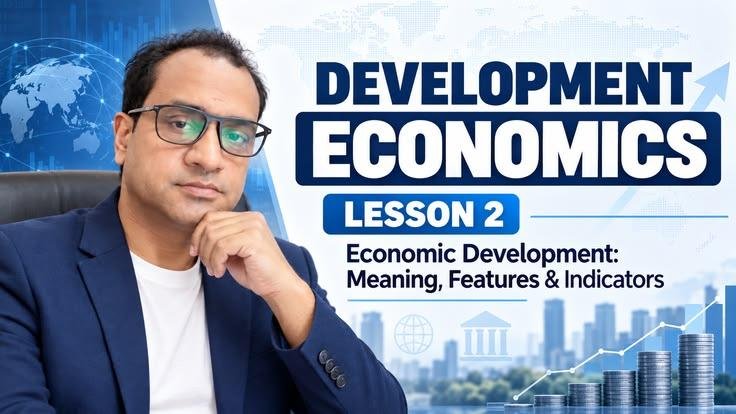
Economic development is one of the central concepts in Development Economics. Although the term is frequently used in economics, its meaning has changed considerably over time.
Earlier approaches often identified development with an increase in national income, output, savings, investment, and industrial production. According to this traditional view, an economy became more developed when its production and income increased.
Modern development economics takes a much broader perspective. Economic development involves improvements in people’s standard of living, health, education, employment opportunities, economic security, capabilities, and access to essential goods and services. It also considers poverty, inequality, institutions, gender, environmental sustainability, and the distribution of economic opportunities.
Thus, development is not simply about producing more goods and services. It is about creating conditions in which people can live healthier, more productive, secure, and meaningful lives.
A useful way to understand the concept is:
Economic Development = Economic Progress + Human Well-being + Structural Transformation + Greater Opportunities
This lesson explains the major concepts and approaches used to understand economic development.
2. Meaning of Economic Development
There is no single definition of economic development that captures every aspect of the concept.
In a broad sense, economic development refers to a sustained process of improving the economic and social conditions of a population.
It may involve:
- Higher real income
- Higher productivity
- Better employment opportunities
- Reduction in poverty
- Reduction in severe deprivation
- Improved education
- Better healthcare
- Improved infrastructure
- Greater access to basic services
- Structural transformation
- Improved economic opportunities
- Greater social inclusion
- Environmental sustainability
Development is therefore both an economic and a social process.
3. Traditional Concept of Economic Development
The traditional concept of development was strongly influenced by the experience of industrialization.
Economists often focused on:
- National income
- Per capita income
- Capital formation
- Savings
- Investment
- Industrialization
- Technological progress
- Production
Under this approach, an increase in real national income was considered a major indicator of development.
For example, if a country’s real per capita income increased significantly over time, economists could interpret this as evidence of economic progress.
However, this approach had an important limitation.
An increase in average income does not necessarily mean that every household becomes better off.
Income may increase while:
- Poverty remains high.
- Inequality increases.
- Healthcare remains inadequate.
- Education remains inaccessible.
- Unemployment remains high.
- Environmental damage increases.
This limitation encouraged economists to develop broader concepts of development.
4. Modern Concept of Economic Development
Modern development economics views development as a multidimensional process.
The modern approach considers not only how much an economy produces but also who benefits from economic progress and how people’s lives change.
Three broad dimensions are particularly important:
4.1 Increase in Living Standards
Development should increase people’s access to:
- Food
- Housing
- Clothing
- Healthcare
- Education
- Transportation
- Clean water
- Sanitation
- Energy
4.2 Reduction in Poverty and Deprivation
Development involves reducing severe forms of deprivation and expanding people’s ability to meet basic needs.
4.3 Transformation of Economic and Social Structures
Development often involves changes in:
- Production
- Employment
- Technology
- Institutions
- Urbanization
- Education
- Agriculture
- Industry
- Services
Therefore, economic development involves both quantitative and qualitative changes.
5. Economic Development as a Process
Development should not be viewed as a single event.
It is a process that takes place over time.
For example, a country may begin with:
- Low agricultural productivity
- Limited infrastructure
- Low levels of education
- Poor healthcare
- High poverty
Over several decades, it may experience:
- Agricultural modernization
- Industrialization
- Urbanization
- Expansion of education
- Improved healthcare
- Technological advancement
- Growth of modern services
This long-term transformation represents an important aspect of economic development.
6. Economic Development as a Multidimensional Concept
Modern development is multidimensional because human well-being has many dimensions.
A person’s quality of life may depend on:
Income + Health + Education + Employment + Security + Environment + Opportunities
Consequently, development economists study multiple indicators.
Economic indicators
- Real GDP per capita
- Household income
- Productivity
- Employment
- Investment
Social indicators
- Life expectancy
- Literacy
- School enrollment
- Infant mortality
- Access to healthcare
Infrastructure indicators
- Electricity access
- Clean water
- Sanitation
- Transportation
- Digital connectivity
Distributional indicators
- Poverty
- Income inequality
- Wealth inequality
- Gender disparities
7. Income Approach to Development
Income has an important role in development analysis.
Higher income generally increases the resources available to households and governments.
A commonly used indicator is:
Per Capita Income = National Income / Population
For example, suppose a country’s national income is $500 billion and its population is 100 million.
Per capita income would be:
$500 billion ÷ 100 million = $5,000
Per capita income allows economists to make comparisons that take population size into account.
However, per capita income has limitations.
It does not show:
- Income distribution
- Health conditions
- Education quality
- Environmental quality
- Unpaid household work
- Access to public services
- Non-market aspects of well-being
Therefore, income is important but insufficient as a complete measure of development.
8. Welfare Approach to Development
The welfare approach argues that development should ultimately be evaluated according to improvements in human welfare.
Income matters because it can contribute to welfare, but it is not the only factor.
Consider two households with identical incomes.
Household A has:
- Access to good healthcare
- Safe drinking water
- Good schools
- Reliable electricity
Household B lacks these services.
Although their monetary incomes are identical, their living conditions may differ substantially.
This demonstrates why development analysis must go beyond income.
9. Basic Needs Approach
The basic needs approach became influential in development thinking during the twentieth century.
It emphasizes ensuring access to essential goods and services.
Important basic needs include:
- Adequate food
- Clean drinking water
- Shelter
- Sanitation
- Basic healthcare
- Basic education
- Employment
- Personal security
According to this perspective, development policy should ensure that people can meet minimum standards of living.
Economic growth remains important because it can provide resources for meeting these needs, but growth is not treated as the only objective.
10. Capability Approach
The capability approach represents another major development perspective.
It focuses on what people are actually capable of doing and being.
Income is considered an important means rather than the ultimate end of development.
For example, a person may have income but still lack the ability to obtain adequate healthcare or education because services are unavailable.
Similarly, two people with equal income may have different opportunities because of differences in:
- Health
- Disability
- Location
- Social conditions
- Access to public services
- Family circumstances
The capability approach therefore emphasizes people’s real opportunities and freedoms.
11. Functionings and Capabilities
Two important concepts associated with the capability approach are functionings and capabilities.
Functionings
Functionings refer to things a person actually achieves or is.
Examples include:
- Being adequately nourished
- Being educated
- Being healthy
- Being employed
- Participating in society
Capabilities
Capabilities refer to the genuine opportunities available to a person to achieve different functionings.
For example, having access to a school creates an opportunity to become educated.
Therefore:
Functioning = What a person actually achieves
Capability = What a person has the genuine opportunity to achieve
This distinction is important in modern development analysis.
12. Human Development Approach
Human development emphasizes expanding people’s choices and improving their capabilities.
Important dimensions include:
- A long and healthy life
- Access to knowledge
- A decent standard of living
The human development approach therefore moves beyond GDP and considers broader aspects of human well-being.
This perspective has strongly influenced international development measurement.
13. Human Development Index
The Human Development Index, commonly called HDI, combines several dimensions of development.
The three broad dimensions are:
1. Health
Measured using life expectancy at birth.
2. Education
Measured using indicators relating to schooling.
3. Standard of Living
Measured using an income-based indicator.
The HDI is useful because it provides a broader perspective than income alone.
However, HDI also has limitations.
It does not capture every aspect of development, including all dimensions of:
- Inequality
- Political freedom
- Environmental sustainability
- Security
- Institutional quality
- Social inclusion
Therefore, HDI should be interpreted as one indicator rather than a complete measure of development.
14. Development and Structural Change
Development often involves changes in the structure of an economy.
In many traditional economies:
Agriculture → Dominant employment and production sector
As development occurs:
Agriculture → Manufacturing → Modern Services
This simplified sequence is called structural transformation.
However, actual development paths differ across countries.
Some economies have moved from agriculture directly toward services, while others have developed strong manufacturing sectors before expanding modern services.
Structural change is therefore an important but varied feature of development.
15. Development and Productivity
Productivity is central to long-term development.
Productivity refers broadly to the amount of output generated from a given quantity of inputs.
For example:
Labour Productivity = Output / Labour Input
Higher productivity can support:
- Higher wages
- Higher incomes
- Greater competitiveness
- Increased production
- Improved living standards
Productivity can rise through:
- Better technology
- Better education
- Improved infrastructure
- Better management
- Capital investment
- Improved institutions
16. Development and Employment
Employment is an important component of development because work provides income and can contribute to dignity, social participation, and economic security.
However, the quality of employment matters.
A country may have a high employment rate while many workers remain:
- Underpaid
- Informally employed
- Underemployed
- Without social protection
- In low-productivity occupations
Therefore, development economists study both the quantity and quality of employment.
17. Development and Inequality
Economic development does not automatically imply equal distribution of income.
Suppose national income rises from $1 trillion to $1.5 trillion.
If most of the increase benefits a small segment of society, average income will rise while inequality may also increase.
Therefore, development analysis asks two separate questions:
How much has the economy grown?
and
How has the resulting income and opportunity been distributed?
This is why poverty and inequality are major components of development economics.
18. Development and Poverty
Poverty is one of the central concerns of development economics.
Economists distinguish between different concepts of poverty.
Absolute Poverty
Absolute poverty refers to deprivation measured against a specified minimum standard.
Relative Poverty
Relative poverty compares people’s economic resources with those of the broader society.
Modern poverty analysis can also include multiple dimensions such as:
- Education
- Health
- Housing
- Sanitation
- Nutrition
- Electricity
- Living conditions
Therefore, poverty is increasingly viewed as multidimensional rather than purely monetary.
19. Development and Gender
Development outcomes can differ between men and women.
Gender differences may occur in:
- Education
- Employment
- Wages
- Property ownership
- Access to finance
- Healthcare
- Political participation
- Time spent on unpaid work
Development economics therefore studies how economic policies and institutions affect different groups.
Improving opportunities for women can also have implications for household welfare, human capital, productivity, and economic growth.
20. Development and Institutions
Institutions influence how economic activities are organized.
Examples include:
- Property-rights systems
- Legal systems
- Financial institutions
- Government agencies
- Education systems
- Tax systems
- Regulatory institutions
Effective institutions can reduce uncertainty and facilitate investment and exchange.
Institutional development is therefore closely connected with economic development.
21. Development and Environment
Traditional measures of development often emphasized production and income.
Modern development economics also recognizes environmental constraints.
Economic activity can create:
- Pollution
- Resource depletion
- Deforestation
- Climate-related risks
- Biodiversity loss
Development policy therefore increasingly considers sustainability.
A development strategy that raises current income while creating severe long-term environmental damage may create difficult trade-offs between present and future welfare.
22. Development and Freedom
Modern development thinking also recognizes the importance of people’s ability to exercise meaningful choices.
Economic opportunities may include:
- Access to education
- Access to healthcare
- Ability to participate in markets
- Access to employment
- Ability to obtain financial services
- Ability to participate in social and economic institutions
This broadens the concept of development from material wealth toward human opportunity.
23. Quantitative and Qualitative Aspects of Development
Economic development contains both quantitative and qualitative dimensions.
Quantitative Changes
These can include:
- Higher GDP
- Higher income
- Higher investment
- Greater output
- Higher productivity
Qualitative Changes
These can include:
- Better education
- Better healthcare
- Improved institutions
- Greater economic opportunities
- Improved living conditions
- Better environmental quality
A complete analysis of development should consider both.
24. Development as a Long-Term Transformation
Development usually occurs over an extended period.
It involves changes in:
Economic Structure
Agriculture → Industry → Services
Human Capital
Low education → Expanded education and skills
Technology
Traditional methods → Modern technology
Infrastructure
Limited infrastructure → Extensive infrastructure
Institutions
Weak or limited institutions → More developed institutional systems
Living Standards
Basic consumption → Higher and more diversified consumption
These transformations interact with one another.
For example, better education can increase productivity, which can raise income, which can increase demand for better services.
25. Major Approaches to Understanding Development
We can summarize the major approaches as follows:
| Approach | Main Focus |
|---|---|
| Income Approach | Income and production |
| Growth Approach | Long-term output growth |
| Basic Needs Approach | Essential goods and services |
| Welfare Approach | Human well-being |
| Capability Approach | People’s real opportunities |
| Human Development Approach | Health, education and living standards |
| Structural Approach | Transformation of economic structure |
| Sustainable Development Approach | Present and future well-being |
No single approach captures every dimension of development.
Modern development economics therefore uses several perspectives together.
26. Development Versus Underdevelopment
Underdevelopment does not simply mean that an economy has low income.
It may involve a combination of:
- Low productivity
- High poverty
- Limited infrastructure
- Weak human capital
- Limited access to finance
- High informality
- Poor health outcomes
- Limited technological capacity
- Institutional constraints
Similarly, development is not simply the opposite of one particular characteristic.
It represents a broad process of economic and social transformation.
27. Why the Concept of Development Has Changed
The concept of development has evolved because economists recognized that economic growth alone could not explain all improvements or problems in human welfare.
Several factors contributed to this evolution:
- Recognition of persistent poverty
- Increased attention to inequality
- Greater importance given to education and health
- Research on human capabilities
- Greater attention to gender
- Recognition of environmental constraints
- Better development data
- Greater focus on institutions
- Evidence concerning the distribution of economic growth
As a result, development economics has become increasingly interdisciplinary.
28. Important Distinction: Growth, Development and Welfare
These three concepts should not be treated as identical.
Growth
Primarily concerns an increase in economic output.
Development
Concerns broader economic and social transformation and improvements in opportunities and living conditions.
Welfare
Concerns people’s overall well-being.
They are related but distinct concepts.
For example:
Growth → More resources
Development → Transformation and expanded opportunities
Welfare → Improvements in human well-being
The relationships among these concepts are important throughout development economics.
29. Practical Example
Imagine a developing economy that experiences rapid expansion of manufacturing.
Factories increase production and exports.
As a result:
- GDP increases.
- Employment increases.
- Tax revenue increases.
- Household incomes rise.
- Infrastructure improves.
However, suppose:
- Pollution also increases.
- Some workers remain poorly paid.
- Rural poverty remains high.
- Access to healthcare remains unequal.
The economy has clearly experienced economic growth.
Whether this growth constitutes broad-based economic development depends on the wider changes in living standards, opportunities, poverty, inequality, institutions, and environmental conditions.
This example demonstrates why development economics uses a multidimensional perspective.
30. Key Characteristics of Economic Development
The concept of development can be summarized through the following characteristics:
- It is a long-term process.
- It is multidimensional.
- It involves economic growth.
- It involves structural transformation.
- It seeks improvements in living standards.
- It involves poverty reduction.
- It considers inequality.
- It emphasizes human capital.
- It considers institutions.
- It increasingly emphasizes sustainability.
31. Lesson Summary
Economic development is a broad and multidimensional concept.
The traditional approach emphasized increases in national income, output, capital formation, and industrialization. Modern development economics recognizes that these factors are important but insufficient by themselves.
Development also involves:
Poverty reduction + Better health + Better education + Productive employment + Greater opportunities + Structural transformation + Inclusion + Sustainability
The income approach remains useful because income provides resources for improving living standards. However, income alone cannot fully capture human welfare.
The basic needs approach emphasizes essential goods and services.
The capability approach focuses on people’s genuine opportunities and freedoms.
The human development approach emphasizes health, education, and living standards.
The structural transformation approach focuses on changes in the composition of production and employment.
The sustainable development approach considers the relationship between present economic progress and future generations.
Together, these approaches provide a more complete understanding of development.
32. Key Terms
Economic Development: A long-term process of economic and social transformation that improves human well-being and expands opportunities.
Per Capita Income: Average income calculated by dividing national income by population.
Human Development: A development perspective focused on expanding people’s capabilities and improving health, education, and living standards.
Basic Needs: Essential goods and services required for an acceptable standard of living.
Capability: A person’s genuine opportunity to achieve valued outcomes.
Functioning: What a person actually achieves or becomes.
Structural Transformation: Changes in the composition of economic production and employment.
Human Capital: Knowledge, skills, education, and health embodied in people.
Sustainable Development: Development that considers both present needs and the ability of future generations to meet their needs.
33. Multiple-Choice Questions
1. Economic development is generally considered:
A. A purely monetary concept
B. A multidimensional process
C. Only an increase in exports
D. Only an increase in population
Answer: B. A multidimensional process
2. Per capita income is calculated as:
A. Population ÷ National Income
B. National Income ÷ Population
C. GDP × Population
D. Exports ÷ Imports
Answer: B. National Income ÷ Population
3. The basic needs approach emphasizes:
A. Luxury consumption
B. Essential goods and services
C. Stock-market performance
D. Exchange-rate movements only
Answer: B. Essential goods and services
4. The capability approach focuses primarily on:
A. Gold reserves
B. People’s genuine opportunities and abilities
C. Government debt
D. Export prices
Answer: B. People’s genuine opportunities and abilities
5. Which is an example of a functioning?
A. Being adequately nourished
B. Having a potential opportunity only
C. A tax rate
D. A country’s exchange rate
Answer: A. Being adequately nourished
6. Structural transformation refers to:
A. Changes in the structure of economic activity
B. Changes in currency design
C. Changes in interest rates only
D. Changes in accounting procedures
Answer: A. Changes in the structure of economic activity
7. Which is a limitation of per capita income as a development indicator?
A. It cannot show income distribution
B. It measures population
C. It measures inflation perfectly
D. It measures education directly
Answer: A. It cannot show income distribution
8. Human development gives substantial importance to:
A. Health and education
B. Only exports
C. Only industrial output
D. Only government borrowing
Answer: A. Health and education
9. Sustainable development considers:
A. Only present consumption
B. Present and future well-being
C. Only industrial growth
D. Only agricultural production
Answer: B. Present and future well-being
10. Which of the following can be considered a qualitative aspect of development?
A. Better healthcare
B. Higher GDP only
C. Higher output only
D. Higher exports only
Answer: A. Better healthcare
34. Short-Answer Questions
- Define economic development.
- Explain the traditional concept of development.
- What is the modern concept of economic development?
- Why is development considered multidimensional?
- Explain the income approach to development.
- What is the basic needs approach?
- Explain the capability approach.
- Distinguish between functionings and capabilities.
- What is structural transformation?
- Why is per capita income not a complete measure of development?
- Explain the relationship between development and poverty.
- Why is human capital important for development?
- How does environmental sustainability relate to development?
- Distinguish between quantitative and qualitative aspects of development.
- Explain the difference between economic growth and economic development.
35. Long-Answer Questions
- Define economic development and explain its major characteristics.
- Discuss the evolution of the concept of economic development.
- Explain the traditional and modern approaches to economic development.
- Discuss the basic needs approach to development.
- Explain the capability approach and distinguish between capabilities and functionings.
- Discuss the multidimensional nature of economic development.
- Explain why per capita income alone cannot be used as a complete measure of development.
- Discuss the relationship between economic growth, economic development, and human welfare.
- Explain the importance of structural transformation in economic development.
- Discuss the role of sustainability in the modern concept of economic development.
36. Examination Revision Points
Remember these key points:
Traditional Development → Income + Output + Capital Formation
Modern Development → Income + Health + Education + Opportunities + Poverty Reduction + Inclusion + Sustainability
Per Capita Income = National Income ÷ Population
Functioning = What a person actually achieves
Capability = What a person has the genuine opportunity to achieve
Structural Transformation = Change in the composition of production and employment
Development = A long-term, multidimensional process
4 thoughts on “Lesson 2: Meaning and Concepts of Economic Development”