
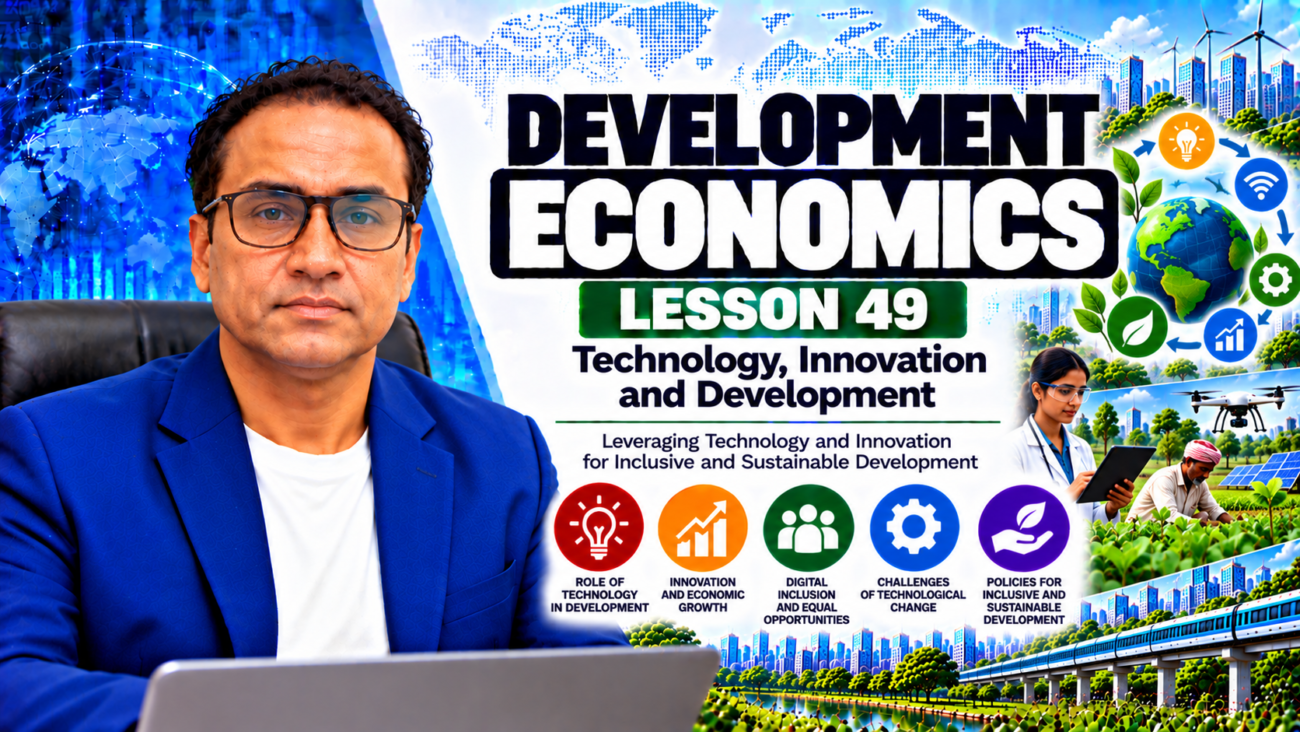
Lesson 49: International Aid, Foreign Assistance and Economic Development
Lesson Overview
International aid and foreign assistance have played an important role in the economic development of many developing countries. Governments and institutions often face shortages of domestic savings, foreign exchange, technology, infrastructure, and technical expertise. Foreign assistance can help address some of these constraints by providing financial resources, goods, technical knowledge, emergency support, and institutional assistance. At the same time, aid is not automatically successful. Its effects depend on how resources are allocated, the quality of institutions, domestic policies, implementation capacity, political conditions, and the objectives of both donors and recipient countries. This lesson examines the meaning and forms of foreign assistance, the relationship between aid and economic growth, humanitarian and development assistance, conditionality, aid effectiveness, debt sustainability, governance, and the role of aid in long-term development.
1. Meaning and Nature of International Aid and Foreign Assistance
International aid refers broadly to resources transferred from one country, international organization, or institution to another country for purposes associated with economic development, poverty reduction, humanitarian relief, public services, infrastructure, capacity building, or emergency response. Foreign assistance is a broader expression that may include grants, concessional loans, technical assistance, food assistance, humanitarian relief, budget support, project financing, and other forms of international cooperation. Aid can be provided by governments, multilateral institutions, development agencies, foundations, and other organizations. The central idea is that resources originating outside the recipient economy are made available to support particular development or humanitarian objectives.
Foreign assistance can take several forms. A grant is a transfer that does not normally require repayment, while a concessional loan provides financing on terms that are more favorable than ordinary commercial borrowing. Technical assistance may involve experts, training, institutional support, research, or knowledge transfer. Humanitarian assistance is generally directed toward immediate needs created by disasters, conflicts, food shortages, displacement, or other emergencies. Development assistance is more commonly associated with longer-term objectives such as education, healthcare, infrastructure, agricultural development, governance, and economic capacity.
The objectives of aid have also changed over time. In some periods, assistance was strongly connected with geopolitical considerations and international strategic interests. In other periods, poverty reduction, human development, environmental sustainability, health, education, and institution building became increasingly important objectives. Consequently, aid should not be viewed as a single uniform activity. Its purpose, design, conditions, duration, source, and delivery mechanism can differ substantially.
For developing economies, foreign assistance can be particularly relevant when domestic resources are insufficient to finance essential investments. However, the existence of a resource gap does not mean that every aid program will produce successful development outcomes. The effectiveness of assistance depends on whether resources address genuine constraints and whether recipient institutions have the capacity to use them productively.
2. Types and Forms of Foreign Assistance
Foreign assistance can be classified according to its purpose, financing structure, source, and method of delivery. Bilateral aid is provided directly by one government to another government or organizations within the recipient country. Multilateral aid is provided through international institutions and development organizations that pool resources from multiple countries and allocate them to development programs. These two forms can operate simultaneously and may support similar development objectives.
Financial assistance is one of the most recognizable forms of aid. It may finance infrastructure projects, public health programs, education systems, agricultural development, environmental projects, social protection, or government programs. Grants are particularly useful where the recipient country has limited repayment capacity because they do not create the same debt obligation as loans. Concessional loans can also provide valuable financing because they normally carry lower interest rates and longer repayment periods than commercial borrowing.
Project assistance is directed toward specific activities. For example, an assistance program might finance a rural road project, irrigation system, school construction program, hospital improvement project, or renewable-energy facility. Program assistance, by contrast, can provide broader support for government policies or public expenditure programs. Technical assistance focuses less on transferring financial resources and more on transferring knowledge, expertise, management capacity, technology, and institutional practices.
Humanitarian assistance has a different immediate purpose. When a country experiences an earthquake, flood, drought, armed conflict, epidemic, or severe food shortage, international organizations and donor governments may provide emergency food, medicine, shelter, clean water, and logistical support. Such assistance can save lives even when it does not directly increase long-term productive capacity. Development assistance generally operates over a longer period and attempts to address underlying economic and social constraints.
3. The Role of Aid in Economic Growth and Capital Formation
One traditional argument for foreign aid is based on the idea of a savings and investment gap. Developing countries may have significant investment opportunities but insufficient domestic savings to finance them. If foreign assistance supplements domestic resources, it can potentially increase investment in physical capital, human capital, infrastructure, technology, and productive activities.
Suppose a country has substantial infrastructure needs but domestic savings are too low to finance the required investment. Foreign assistance may provide additional resources for roads, electricity, irrigation, schools, hospitals, or digital infrastructure. These investments can increase productive capacity if they are properly designed and maintained. Better infrastructure can reduce transportation costs, improve market access, increase business productivity, and support private investment.
Aid can also address a foreign-exchange constraint. Developing countries often need imported machinery, equipment, energy products, technology, or intermediate goods to expand domestic production. A shortage of foreign currency may prevent firms and governments from importing these essential inputs. Foreign assistance can provide foreign exchange and therefore support investment and productive transformation.
However, the relationship between aid and growth is not mechanical. Financial resources alone cannot guarantee productive investment. If institutions are weak, projects are poorly selected, corruption is widespread, maintenance is neglected, or resources are diverted toward unproductive activities, the developmental impact may be limited. Therefore, the quality of investment and the institutional environment are as important as the amount of assistance received.
4. Foreign Aid, Poverty Reduction and Human Development
Foreign assistance is frequently directed toward reducing poverty and improving human development. Poverty is multidimensional and involves more than low income. Poor households may face inadequate nutrition, limited access to healthcare, poor-quality education, unsafe water, inadequate sanitation, insecure housing, and restricted economic opportunities. Aid programs can address several of these constraints simultaneously.
Health assistance can support vaccination, maternal healthcare, disease prevention, medical infrastructure, health-worker training, and access to essential medicines. Education assistance may finance schools, teacher training, educational materials, scholarships, vocational education, and digital learning infrastructure. Social protection programs can help vulnerable households maintain consumption during economic crises or other shocks.
Agricultural assistance can be particularly significant in economies where a large proportion of the population depends on farming. Support for irrigation, agricultural research, improved seeds, extension services, storage, rural roads, and market access can raise agricultural productivity and household incomes. When rural productivity increases, the effects may extend beyond agriculture because higher rural incomes can increase demand for local goods and services.
The effectiveness of poverty-oriented aid depends on whether programs reach intended beneficiaries. A project may have an impressive budget but limited impact if implementation is weak or resources are captured by better-connected groups. Effective targeting, monitoring, transparency, local participation, and institutional accountability therefore matter greatly.
5. Conditionality, Governance and Aid Effectiveness
Foreign assistance is sometimes provided with conditions. Aid conditionality means that financial support is linked to specified policy actions, institutional reforms, or performance requirements. Conditions may involve public financial management, economic reforms, governance, fiscal policies, transparency, environmental standards, or sector-specific objectives.
Supporters of conditionality argue that conditions can encourage reforms that improve economic management and strengthen institutions. For example, assistance may be linked to improvements in budget transparency or the establishment of systems for monitoring public expenditure. Conditions can also be intended to ensure that donor resources are used for agreed purposes.
However, conditionality can create difficulties. If conditions are too numerous, unrealistic, or poorly adapted to local circumstances, recipient governments may struggle to implement them. Conditionality may also create tensions over national policy autonomy. A policy that appears appropriate from outside may not always fit the institutional, political, social, or economic conditions of the recipient country.
Aid effectiveness therefore requires cooperation between donors and recipients. Recipient governments need ownership of development programs, while donors need to understand local conditions and avoid unnecessary fragmentation. When many donors finance overlapping projects with different reporting requirements, governments may spend substantial administrative resources coordinating aid rather than delivering public services.
Good governance can strengthen the impact of assistance. Transparent procurement, reliable public financial management, independent auditing, effective institutions, and public accountability can reduce leakage and improve the allocation of resources. Nevertheless, governance reforms themselves are complex and generally require sustained institutional development rather than short-term interventions.
6. Aid, Debt and Debt Sustainability
Not all foreign assistance is provided as grants. Loans, including concessional loans, create repayment obligations. When borrowing is used to finance productive investments that generate sufficient economic returns, it can contribute to long-term development. But excessive borrowing can create debt-service pressures and reduce the government’s ability to finance essential public services and development programs.
Debt sustainability refers to the ability of a country to meet its current and future debt obligations without creating severe economic or fiscal instability. Several factors influence debt sustainability, including interest rates, repayment periods, economic growth, export earnings, government revenue, exchange rates, and the composition of debt.
Foreign-currency borrowing creates additional risks. If a government borrows in a foreign currency while its revenues are mainly denominated in domestic currency, depreciation of the domestic currency can increase the domestic-currency cost of debt repayment. External shocks such as commodity-price declines, natural disasters, global recessions, or financial crises can also reduce foreign-exchange earnings and make debt repayment more difficult.
For this reason, development assistance should not be evaluated simply by the amount of money transferred. The financing terms matter. Grants generally impose no repayment burden, while concessional loans impose a lower burden than commercial loans. A responsible development strategy considers both the immediate benefits of external financing and the future obligations created by that financing.
7. Aid, Technology Transfer, Institutions and Local Capacity
Foreign assistance can contribute to development by transferring knowledge and building domestic capabilities. Technical cooperation can help governments improve statistical systems, tax administration, agricultural research, public health, education, environmental management, digital services, and infrastructure planning. Universities, research institutions, firms, and government agencies may all participate in such knowledge transfer.
Technology transfer can be especially important for developing economies. External assistance may introduce new production methods, agricultural technologies, renewable-energy systems, digital platforms, medical technologies, or industrial processes. However, receiving technology is different from developing the ability to maintain and improve it. Sustainable technology transfer requires local skills, institutions, financing, maintenance capacity, and opportunities for learning.
Capacity building is therefore an important component of effective development assistance. If an aid-funded project depends permanently on foreign experts, its long-term contribution may be limited. By contrast, if local workers are trained and institutions acquire the knowledge required to operate and improve the project, the benefits can continue after external financing ends.
Aid can also contribute to institution building when it supports systems rather than isolated projects. Improvements in budgeting, data collection, procurement, public administration, health systems, education management, and regulatory capacity can influence many sectors simultaneously. Nevertheless, institution building is a long-term process and cannot normally be achieved through short-term financial transfers alone.
8. The Future Role of Foreign Assistance in Sustainable Development
The role of international aid is changing as developing economies face new challenges. Climate change, global health risks, food insecurity, digital inequality, migration, natural disasters, energy transitions, and economic shocks require forms of international cooperation that extend beyond traditional development projects.
Climate-related assistance can support renewable energy, climate adaptation, disaster resilience, sustainable agriculture, water management, and low-carbon infrastructure. Developing countries may face particularly high adaptation costs despite having relatively limited historical responsibility for global emissions. International cooperation can therefore help finance investments that would otherwise be difficult for poorer countries to undertake.
Aid can also support the Sustainable Development Goals by contributing to health, education, poverty reduction, gender equality, clean water, infrastructure, environmental protection, and institutional development. Increasingly, development assistance is being considered alongside private investment, domestic resource mobilization, trade, technology cooperation, and remittances rather than as an isolated source of development finance.
The long-term objective should be to strengthen the capacity of developing economies to generate sustainable growth using their own productive resources while making effective use of international cooperation. Foreign assistance can help countries overcome temporary resource constraints and build capabilities, but it cannot substitute permanently for domestic institutions, productive investment, human capital, entrepreneurship, effective governance, and sound economic policies.
Thus, international aid should be understood as one component of a broader development strategy. Its contribution depends on the quality of the projects supported, the incentives created, the institutions involved, the financing terms, the participation of local communities, and the capacity of recipient economies to convert external resources into lasting productive capabilities.
Key Concepts
- International Aid – Resources transferred internationally to support development, humanitarian relief, or related objectives.
- Foreign Assistance – A broad category including grants, loans, technical assistance, humanitarian support, and development programs.
- Bilateral Aid – Assistance provided directly from one country to another.
- Multilateral Aid – Assistance provided through international organizations involving multiple countries.
- Grant – Financial assistance that normally does not require repayment.
- Concessional Loan – A loan provided on relatively favorable terms, such as lower interest or longer repayment periods.
- Technical Assistance – Transfer of expertise, knowledge, training, or institutional support.
- Aid Conditionality – Conditions attached to assistance concerning policies, reforms, performance, or resource use.
- Aid Effectiveness – The extent to which aid achieves its intended development outcomes.
- Debt Sustainability – The ability of a country to meet debt obligations without creating severe economic or fiscal problems.
- Capacity Building – Development of skills, institutions, systems, and organizational capabilities.
- Humanitarian Assistance – Emergency assistance intended to protect lives and meet basic needs during crises.
- Development Assistance – External support directed toward longer-term economic and social development.
- Foreign-Exchange Constraint – A shortage of foreign currency that limits the ability to purchase imports.
- Aid Dependency – A situation in which an economy or government becomes substantially reliant on external assistance.
Assessment Section
A. Multiple-Choice Questions
1. International aid primarily refers to:
A. Domestic taxation
B. Resources transferred internationally for development or humanitarian purposes
C. Private household savings
D. Domestic inflation
Answer: B
2. Which form of assistance normally does not require repayment?
A. Commercial loan
B. Concessional loan
C. Grant
D. External bond
Answer: C
3. Bilateral aid is provided:
A. Through domestic banks only
B. Directly from one country to another
C. Only through private companies
D. Only through households
Answer: B
4. Multilateral aid is generally provided through:
A. International institutions
B. Individual households
C. Local shops
D. Domestic consumers
Answer: A
5. A concessional loan generally has:
A. Less favorable terms than commercial borrowing
B. No repayment obligation under any circumstances
C. More favorable financing terms than ordinary commercial loans
D. No economic value
Answer: C
6. Technical assistance mainly involves:
A. Transfer of knowledge and expertise
B. Increasing import tariffs
C. Reducing domestic savings
D. Increasing inflation
Answer: A
7. Aid conditionality means:
A. Aid is always provided without requirements
B. Assistance is linked to specified conditions or policy actions
C. Aid is provided only to households
D. Aid can never be monitored
Answer: B
8. Debt sustainability concerns a country’s ability to:
A. Eliminate all imports
B. Meet its debt obligations over time
C. Stop economic growth
D. Avoid all foreign investment
Answer: B
9. Humanitarian assistance is primarily designed to:
A. Respond to immediate crises and basic human needs
B. Increase luxury consumption
C. Eliminate international trade
D. Replace domestic taxation permanently
Answer: A
10. One important long-term objective of development assistance is:
A. Permanent dependence on foreign resources
B. Building domestic productive and institutional capacity
C. Eliminating domestic investment
D. Preventing technological development
Answer: B
B. True or False
- Foreign assistance can include both grants and loans. True
- All foreign aid automatically produces economic growth. False
- Technical assistance can transfer knowledge and expertise. True
- Bilateral aid involves two countries directly. True
- Grants normally create the same repayment obligation as loans. False
- Excessive external borrowing can create debt-service problems. True
- Humanitarian assistance is generally associated with immediate emergency needs. True
- Good institutions can influence the effectiveness of aid. True
- Aid conditionality never creates policy challenges. False
- Foreign aid can permanently substitute for domestic economic capacity. False
C. Fill in the Blanks
- Assistance provided directly from one country to another is called __________ aid.
Answer: bilateral - A transfer that normally does not require repayment is called a __________.
Answer: grant - Assistance provided through international institutions is called __________ aid.
Answer: multilateral - A loan offered on favorable terms is called a __________ loan.
Answer: concessional - The transfer of knowledge and expertise is known as __________ assistance.
Answer: technical - Conditions attached to foreign assistance are known as aid __________.
Answer: conditionality - The ability of a country to meet its debt obligations is related to debt __________.
Answer: sustainability - Emergency assistance following disasters is called __________ assistance.
Answer: humanitarian - Development of institutional and human capabilities is called capacity __________.
Answer: building - A shortage of foreign currency may create a foreign-__________ constraint.
Answer: exchange
D. Short-Answer Questions
1. What is international aid?
International aid is the transfer of financial resources, goods, technical expertise, or other forms of support from external governments, institutions, or organizations to another country for development, humanitarian, or related purposes.
2. Distinguish between bilateral and multilateral aid.
Bilateral aid is provided directly by one country to another. Multilateral aid is provided through international institutions that coordinate resources from several countries and allocate them to recipient countries or programs.
3. What is a concessional loan?
A concessional loan is a loan provided on more favorable terms than ordinary commercial borrowing, often involving lower interest rates, longer repayment periods, or other favorable conditions.
4. Why can foreign assistance support capital formation?
Foreign assistance can supplement domestic savings and provide resources for investment in infrastructure, machinery, education, health, technology, and other forms of productive capital.
5. What is aid conditionality?
Aid conditionality occurs when financial or other assistance is linked to specified policies, reforms, performance requirements, or conditions concerning how resources are used.
6. Why is debt sustainability important?
Debt sustainability is important because borrowing creates future repayment obligations. Excessive debt can reduce fiscal flexibility and create difficulties in financing essential public services and development investments.
7. What is technical assistance?
Technical assistance involves providing knowledge, expertise, training, technology, research support, or institutional assistance to strengthen domestic capabilities.
8. How can aid contribute to poverty reduction?
Aid can support healthcare, education, social protection, agricultural development, infrastructure, employment programs, and other interventions that improve living standards and economic opportunities.
E. Long-Answer Questions
1. Explain the major forms of international aid and foreign assistance.
International assistance can take the form of grants, concessional loans, technical assistance, humanitarian assistance, project financing, program assistance, and capacity-building programs. Grants do not normally require repayment, while loans create repayment obligations. Bilateral assistance comes directly from one government to another, whereas multilateral assistance is provided through international organizations. Technical assistance focuses on knowledge and expertise, while humanitarian assistance addresses immediate needs created by disasters, conflicts, epidemics, and other emergencies. Development assistance generally focuses on longer-term economic and social improvements.
2. Explain the relationship between foreign assistance and economic growth.
Foreign assistance can increase the resources available for investment when domestic savings are insufficient. It can finance infrastructure, education, health, agricultural development, technology, and productive capacity. It may also relax foreign-exchange constraints by enabling countries to import machinery, equipment, and technology. However, aid does not automatically create growth. Its impact depends on project quality, institutional capacity, governance, incentives, implementation, and maintenance. Therefore, external resources are most productive when they complement rather than replace domestic development capacity.
3. Discuss the relationship between aid and poverty reduction.
Aid can reduce poverty by supporting education, healthcare, social protection, agricultural productivity, infrastructure, and employment opportunities. Health programs can reduce preventable illness, while education programs can improve human capital. Agricultural investments can raise rural incomes, and infrastructure can connect poor communities to markets. However, effective targeting and implementation are essential. If resources are poorly managed or captured by powerful groups, the effect on poverty may be limited.
4. Discuss the importance of debt sustainability in foreign assistance.
Loans can provide valuable development finance, particularly when they finance productive investments. However, loans create future repayment obligations. If borrowing grows faster than government revenue, exports, or productive capacity, debt-service burdens can increase. Foreign-currency debt creates additional exchange-rate risk. Consequently, countries need to evaluate the financing terms, expected economic returns, repayment capacity, and broader fiscal implications of external borrowing.
F. Analytical Questions
1. Why might the same amount of foreign aid produce different outcomes in two developing countries?
The outcomes may differ because countries have different institutional quality, governance systems, human capital, infrastructure, administrative capacity, political conditions, economic structures, and project-management capabilities. A country with strong institutions may convert external resources into productive investments more effectively, while a country with weak implementation capacity may experience delays, leakage, or inefficient allocation.
2. Explain how foreign aid can relax both savings constraints and foreign-exchange constraints.
Foreign assistance can supplement domestic savings by providing additional resources for investment. At the same time, it can provide foreign currency needed to import machinery, technology, energy, intermediate goods, and other inputs. Therefore, aid can potentially address both domestic resource shortages and external financing constraints.
3. Why might grants be more appropriate than loans in some development situations?
Grants may be more appropriate where projects have strong social benefits but limited direct financial returns or where recipient countries have weak repayment capacity. Health, humanitarian relief, basic education, and disaster response are examples where grants can avoid adding debt burdens while still producing significant social benefits.
4. Explain how technical assistance can produce longer-term benefits than a simple financial transfer.
Technical assistance can strengthen skills, knowledge, institutions, and organizational systems. Once local workers and institutions acquire these capabilities, they may continue using them after the original assistance program ends. This can create longer-lasting effects than a financial transfer that is spent without building domestic capacity.
G. Critical-Thinking Questions
1. “More foreign aid does not necessarily mean more development.” Discuss.
The statement reflects the fact that development depends on how resources are used rather than simply on the volume of external finance. Large aid flows can support infrastructure, education, healthcare, and productive investment, but poor governance, weak institutions, unsuitable projects, inadequate maintenance, and excessive dependence can reduce their effectiveness. Therefore, the quality, design, implementation, and institutional environment surrounding aid are critical.
2. Should developing countries rely heavily on foreign assistance for long-term development?
Foreign assistance can be valuable, particularly during periods of severe resource constraints, emergencies, or major investment requirements. However, long-term development generally requires domestic savings, productive investment, human capital, effective institutions, entrepreneurship, technological capability, and sustainable public finances. Foreign assistance is therefore better understood as a complement to domestic development capacity rather than a permanent substitute for it.
3. How can developing countries improve the effectiveness of foreign assistance?
They can improve effectiveness through transparent public financial management, careful project selection, strong monitoring and evaluation, local participation, better coordination among donors, investment in domestic capacity, appropriate debt management, and alignment of assistance with national development priorities.
H. Comprehensive Answer Key
MCQs
- B
- C
- B
- A
- C
- A
- B
- B
- A
- B
True/False
- True
- False
- True
- True
- False
- True
- True
- True
- False
- False
Fill in the Blanks
- Bilateral
- Grant
- Multilateral
- Concessional
- Technical
- Conditionality
- Sustainability
- Humanitarian
- Building
- Exchange
Lesson Summary
International aid and foreign assistance can provide developing economies with financial resources, foreign exchange, technology, expertise, emergency support, and institutional assistance. They can contribute to capital formation, poverty reduction, human development, infrastructure, and productive transformation. However, aid is not automatically effective. Its impact depends on institutional quality, governance, local ownership, project design, implementation capacity, financing conditions, and the ability of recipient countries to build lasting domestic capabilities. Grants and concessional finance can reduce financing constraints, while technical assistance can strengthen human and institutional capacity. At the same time, excessive reliance on external financing can create debt and dependency risks. The central development lesson is therefore that foreign assistance is most useful when it complements domestic resources and strengthens the long-term productive and institutional capacity of developing economies.
Key Learning Outcomes
After completing this lesson, a student should be able to:
- Define international aid and foreign assistance.
- Distinguish between bilateral and multilateral assistance.
- Explain grants, concessional loans, and technical assistance.
- Analyze the relationship between aid and capital formation.
- Explain how aid can contribute to poverty reduction and human development.
- Understand aid conditionality and its potential implications.
- Explain debt sustainability and external borrowing risks.
- Discuss the role of technology transfer and capacity building.
- Evaluate the conditions that influence aid effectiveness.
- Explain why foreign assistance should generally complement domestic development capacity.
Next Lesson: Lesson 50 – Remittances, Migration and Economic Development
If you want, I can continue with Lesson 50 in the same eight-passage, human-written professor format with the complete assessment and answer key.

One thought on “Lesson 49: International Aid, Foreign Assistance and Economic Development”