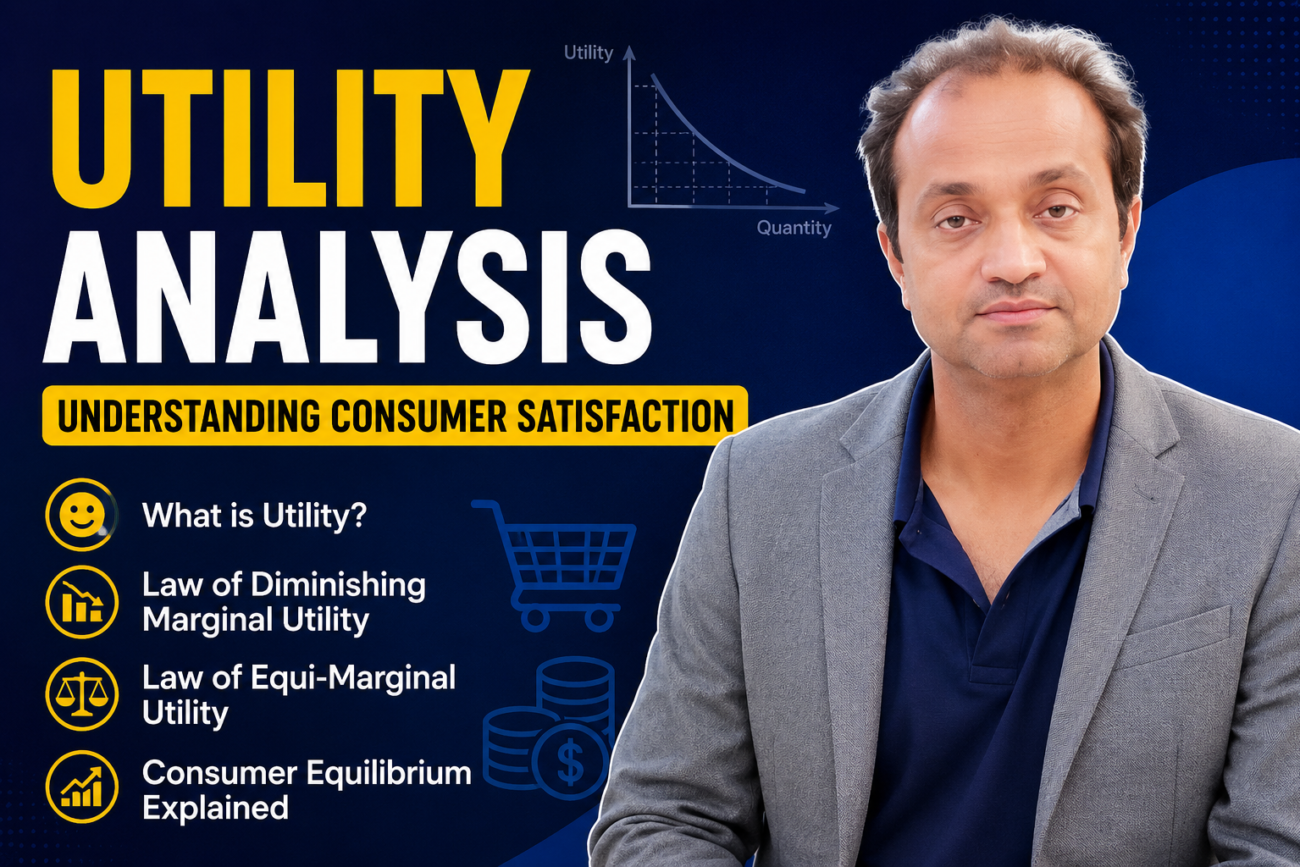
Eco is not just about money, markets, and businesses—it is also about people and the choices they make every day. One of the most interesting concepts in Economics is Utility Analysis, which explains why consumers buy certain goods and services and how they derive satisfaction from them. In simple words, utility analysis studies human wants and the satisfaction people receive from consuming different commodities.
Imagine walking into a supermarket in America. You have limited dollars in your pocket, but there are hundreds of products around you—burgers, coffee, smartphones, clothes, and video games. Since you cannot buy everything, you make choices. Economics tries to understand these choices, and utility analysis provides the foundation for understanding consumer behavior.
What is Utility?
In economics, utility refers to the satisfaction or pleasure that a consumer derives from consuming a good or service. It does not mean usefulness in the ordinary sense. A product may not be useful for survival but can still provide utility if it gives satisfaction.
For example, a slice of pizza may not be necessary for survival, but if eating it makes someone happy, it provides utility. Likewise, watching movies on a streaming platform provides utility because consumers enjoy entertainment.
Economists use utility as a tool to explain why people spend money on different products and services.
Features of Utility
Utility has several important characteristics:
1. Utility is Subjective
Different individuals derive different levels of satisfaction from the same product. A cup of coffee may give immense pleasure to one person but none to another.
2. Utility Varies from Person to Person
Consumer preferences differ due to age, income, culture, and tastes. What is valuable for one consumer may be less valuable for another.
3. Utility Changes with Time and Place
The same commodity may provide different utility under different circumstances. For example, ice cream provides greater satisfaction during summer than winter.
4. Utility is Psychological
Utility cannot be directly measured because satisfaction exists in the consumer’s mind.
Cardinal Utility Analysis
Early economists such as William Stanley Jevons, Alfred Marshall, and Leon Walras believed that utility could be measured numerically. This approach is known as Cardinal Utility Analysis.
According to this theory, utility can be measured in imaginary units called utils.
For example:
- First slice of pizza = 20 utils
- Second slice = 15 utils
- Third slice = 10 utils
This theory assumes consumers can express satisfaction numerically.
Assumptions of Cardinal Utility Analysis
- Utility is measurable.
- Money has constant marginal utility.
- Consumers behave rationally.
- Consumers aim to maximize satisfaction.
- Utilities of different goods are independent.
Although these assumptions simplify analysis, modern economists criticize them because measuring satisfaction exactly is difficult.
Total Utility and Marginal Utility
Two important concepts in utility analysis are Total Utility (TU) and Marginal Utility (MU).
Total Utility
Total utility refers to the total satisfaction obtained from consuming a certain quantity of a commodity.
For example:
| Cups of Coffee | Total Utility |
|---|---|
| 1 | 20 |
| 2 | 35 |
| 3 | 45 |
| 4 | 50 |
| 5 | 50 |
The consumer’s total satisfaction increases initially but eventually stops increasing.
Marginal Utility
Marginal utility is the additional satisfaction obtained from consuming one more unit of a commodity.
Formula:
MU = Change in Total Utility / Change in Quantity
Using the above example:
| Cups of Coffee | Total Utility | Marginal Utility |
| 1 | 20 | 20 |
| 2 | 35 | 15 |
| 3 | 45 | 10 |
| 4 | 50 | 5 |
| 5 | 50 | 0 |
The table clearly shows that marginal utility declines as consumption increases.
Law of Diminishing Marginal Utility
The Law of Diminishing Marginal Utility was developed by Alfred Marshall. It states that as a consumer consumes more and more units of a commodity, the additional satisfaction derived from each extra unit tends to decline.
In everyday American slang, people say, “Too much of a good thing isn’t always good.” That’s exactly what this law means.
Imagine grabbing slices of pizza:
- First slice: “Wow, that’s amazing!”
- Second slice: “Still pretty good.”
- Third slice: “I’m getting full.”
- Fourth slice: “Man, I’m stuffed.”
Each extra slice gives less satisfaction than the previous one.
Assumptions of the Law
- Units consumed should be identical.
- Consumption should be continuous.
- Consumer tastes should remain unchanged.
- Income and prices should remain constant.
- Consumers should act rationally.
Exceptions to the Law
The law may not apply in certain situations:
- Collection of rare stamps
- Addiction to substances
- Increase in wealth or prestige goods
- Hobbies and special interests
However, in most practical situations, the law holds true.
Importance of the Law of Diminishing Marginal Utility
This law has several practical applications:
1. Basis of Consumer Equilibrium
Consumers distribute their income among various goods to maximize satisfaction.
2. Explanation of Demand Curve
As price falls, consumers buy more because marginal utility exceeds price.
3. Basis of Progressive Taxation
The government imposes higher taxes on richer individuals because the utility of money declines as income increases.
4. Supports Welfare Eco
Redistribution of income can increase overall social welfare.
Law of Equi-Marginal Utility
The Law of Equi-Marginal Utility, also known as the Law of Maximum Satisfaction, explains how consumers allocate limited income among different goods.
According to this law, a consumer maximizes satisfaction when the marginal utility per dollar spent on all goods is equal.
Mathematically:
MUx/Px = MUy/Py = MUz/Pz
Where:
- MU = Marginal Utility
- P = Price
Suppose a consumer spends money on burgers and soft drinks. The consumer keeps spending until the satisfaction obtained from the last dollar spent on each product becomes equal.
In modern American slang, people might say:
“You gotta get the best bang for your buck.”
That phrase perfectly captures the essence of equi-marginal utility.
Consumer Equilibrium
A consumer is said to be in equilibrium when there is no desire to change consumption because satisfaction is maximized.
Under cardinal utility analysis:
MUx/Px = MUy/Py = MUm
where MUm is marginal utility of money.
If this condition is not satisfied, consumers rearrange their spending.
Example
Suppose:
| Commodity | MU | Price |
| Pizza | 20 | 10 |
| Soda | 15 | 5 |
MU/P for Pizza = 2
MU/P for Soda = 3
The consumer gets greater satisfaction from soda and should spend more on soda until equality is achieved.
Criticisms of Cardinal Utility Analysis
Despite its importance, the theory faces criticism:
1. Utility Cannot Be Measured
Satisfaction is psychological and cannot be measured in numerical units.
2. Utility of Money is Not Constant
As income changes, the utility of money also changes.
3. Consumer Behavior is Complex
Consumers are influenced by emotions, advertisements, and social factors.
4. Unrealistic Assumptions
Perfect rationality rarely exists in real life.
Because of these criticisms, economists developed a new approach known as Ordinal Utility Analysis.
Ordinal Utility Analysis
Economists J.R. Hicks and R.G.D. Allen argued that consumers cannot measure utility numerically. Instead, they can rank preferences.
For example, a consumer may say:
- Burger A is preferred over Burger B.
- Burger B is preferred over Burger C.
This ranking system forms the basis of ordinal utility.
Indifference Curve Analysis
An indifference curve represents combinations of two goods that provide equal satisfaction to the consumer.
The consumer is indifferent between these combinations because each yields the same utility.
Assumptions
- Consumers are rational.
- Preferences are complete.
- Preferences are transitive.
- More goods are preferred to fewer goods.
Properties of Indifference Curves
1. Downward Sloping
To consume more of one good, consumers sacrifice some quantity of another good.
2. Convex to the Origin
This reflects diminishing marginal rate of substitution.
3. Indifference Curves Never Intersect
Intersection would violate consistency in preferences.
4. Higher Curves Indicate Greater Satisfaction
Consumers prefer higher indifference curves because they represent larger quantities of goods.
Budget Line
A budget line represents all possible combinations of goods that a consumer can purchase with a given income.
Formula:
PxX + PyY = M
Where:
- Px = Price of X
- Py = Price of Y
- M = Income
A rise in income shifts the budget line outward, while a fall in income shifts it inward.
Consumer Equilibrium under Indifference Curve Analysis
Consumer equilibrium occurs where:
- Indifference curve is tangent to the budget line.
- Marginal rate of substitution equals price ratio.
At this point, the consumer achieves maximum satisfaction given income constraints.
Modern Relevance of Utility Analysis
Utility analysis remains highly relevant in modern economics.
Businesses use utility concepts to:
- Design pricing strategies
- Study consumer behavior
- Launch new products
- Conduct market research
Streaming services, e-commerce platforms, and social media companies analyze consumer preferences daily to maximize customer satisfaction.
Companies like food delivery apps study purchasing patterns to understand what consumers value the most.
In today’s digital economy, understanding utility is more important than ever.
Conclusion
Utility analysis forms the backbone of consumer theory in economics. It explains how individuals make choices under limited resources and unlimited wants. Concepts such as total utility, marginal utility, the law of diminishing marginal utility, and consumer equilibrium help economists understand market demand and consumer behavior.
While cardinal utility analysis assumes measurable satisfaction, ordinal utility analysis provides a more realistic approach based on consumer preferences. Together, these theories offer valuable insights into human decision-making.
At the end of the day, economics is really about choices. Every time consumers decide whether to buy coffee, stream a movie, or upgrade a smartphone, they are engaging in utility maximization. As people in America often say, “Money talks, but value drives the purchase.” That simple phrase captures the essence of utility analysis—consumers seek the greatest satisfaction from every dollar they spend.